- Throughout a number of scientific books, we are frequently told that Mass (
 ) and Energy (
 ) are related according to the equation
= x  2
2
The factor 2 is the square of the velocity of light. This relationship is based upon Einstein's Theory of Relativity, and has been experimentally confirmed.
- This relationship has had a tremendous influence upon the evolution of our industrialised society. Lured by the promise of endless energy resources, modern science has helped to create a mindless, energy-hungry society. Thus, the present insane efforts to harness nuclear energy gradually evolved. Not surprisingly, there are very few scientific textbooks which do not endorse and glorify Einstein's Theory of Relativity. For example, consider the following statement from Lincoln Barnett's "The Universe and Dr. Einstein".
- = x 2 provides the answer to many of the long-standing mysteries of Physics. It forecasts how many grammes of Uranium must go into a bomb in order to destroy a city. Einstein showed that matter is energy, and energy is matter. Since July 16, 1945, man has been able to transform one into the other. For on that night at Alamagodro, New Mexico, man for the first time transmuted a substantial quantity of matter into light, heat, sound and motion which we call energy.
- What a glorious achievement for science indeed?!
- Furthermore, the Physics textbooks provide several experimental data that attempt to confirm the validity of the Theory of Relativity. However, little or no attempt seems to be made to point out the fragility and weaknesses of the "Relativity" equations. The history of science should have taught us that even the most solid scientific theories have had some weaknesses. It would, therefore, appear that the prospect of infinite sources of energy has caused scientists to lose their objectivity. In the next pages, I will endeavour to demonstrate some of the weaknesses of the Theory of Relativity.
- If we look back at the history of science, then we can recall that (as early as in the 17th century) Galilei had suggested the possibility of measuring the velocity of light. Later, in 1675, the Danish astronomer Olaf Roemer predicted the finite velocity of light by observing the movement of Jupiter's satellites.
- The first successful terrestrial measurements were made with an apparatus constructed by the French scientist Fizeau and later modified by Foucault. Since then, numerous measurements and calculations have been recorded. As a result, we now generally accept the value of the velocity of light to be about 3 x 10⁸ metre/second in the vacuum. When light traverses some transparent media, its velocity diminishes to some degree. Modern scientific textbooks also recognise a duality in the light phenomenon. At times, it has the characteristics of wave motion. At other times, it appears like flying particles which Einstein called "photons". However, in both cases, the velocity is considered to be a vectorial quantity.
- By considering as a vector, a very logical supposition can be made. If the light source is animated by a velocity
 relative to the observer, then the resulting

should be considered. For instance, if a rapid vehicle moved away from us with a velocity of 100 metre/second, and someone aboard this vehicle were to throw an object towards us with a velocity of 120 metre/second, then this object would approach us with a velocity of
120 - 100 = 20 metre/second
Somebody aboard the vehicle can measure the relative velocity (20 metre/second), and he/she knows the starting velocity of the object (120 metre/second). Consequently, he/she can calculate the velocity of the vehicle.
- The American physicist Albert A. Michelson suggested that our planet is similar to a vehicle which travels in the "ether" with a certain velocity, which could be calculated by using the known velocity of light. However, the famous Michelson-Morley experiment (1878) ended in a surprising paradox. It was clearly demonstrated that the relative velocity of light does not depend on the velocity of the light source.
- This paradox inspired mathematicians like Lorentz and Einstein to formulate the Theory of Relativity. First, they decided to consider the velocity of light as a maximum possible velocity in the universe and as a universal constant. Following that, they deduced the necessary mathematical formulae to explain the remaining paradox.
- At this very beginning, they introduced the first contradiction and weakness to their theory. We know today that certain physical phenomena can be transferred over huge distances without any velocity, by what is known as a speed of propagation. Good examples are radio and television transmissions which sometimes use relay stations. Whether a radio broadcasting station is stationary or located in a supersonic jet moving in any direction does not affect our ability to receive those radio signals in the same instant. The media we call "ether" acts like a myriad of individual relay stations, and the signal is transferred from one relay station to another. The speed of the signal propagation depends only on the efficiency and activity of the relay stations.
- It is most probable that the light phenomenon behaves in a similar way. With such a "relay" system, the paradox of the Michelson-Morley experiment is explained. What a pity that radio and television technology had not been developed at the end of the 19th century! Einstein would probably never have introduced his Theory of Relativity. Unaware of the notion of "relays", Lorentz and Einstein confused velocity with the speed of propagation. The speed of light is not a vector. It can not be added or subtracted from another vector, as we can not subtract two pears from three apples. The reason for their confusion is understandable, but their conclusions are nevertheless based on a scientific blunder.
- In the future, science should introduce the subatomic units acting as relays, diffusion stations and receivers in the light phenomenon. Some contemporary physicists believe that atoms and subatomic units may behave like intelligent entities able to intercommunicate. For example, the American physicist Richard P. Feynman demonstrated that subatomic particles are capable of detecting and adopting the most favourable and effortless trajectory. Indeed, it would seem presumptuous to suppose that humans were the only ones capable of creating long-distance "wireless" communication systems. It would be appropriate to assume that Nature already possesses similar but far superior systems of its own.
- Interestingly, this "relay" theory explains not only the paradox of the Michelson-Morley experiment but also all well-known phenomena related to light. The duality of the light phenomenon becomes unnecessary. For example,
- The receiving stations (the "eyes" of this system) record only those signals which are transferred in shortest time by the most efficiently working relay stations. This phenomenon is known as the Fermat principle.
- Sometimes, the last relay station, which transfers the light signal to our eyes, is not located on the straight line between the receiver and the light source. Then, it appears to us that the light is somehow "bent", or more precisely diffracted.
- The light signal influences the relay and receiver stations, and those "intelligent" subatomic units react. Sometimes, we perceive those actions as a form of energy (such as photoelectric effect or the pressure of light). Thus, we no longer need to think of "energy hurtling" through the space.
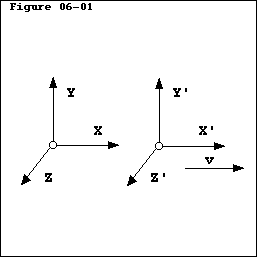
- To continue with our analysis of the Theory of Relativity, let us imagine a coordinate system (
 ',
', ',
', '), moving relatively to another resting coordinate system (,,), animated by a velocity in the direction or ', as shown in Figure 06-01. If we want to describe a movement which occurs in the moving system and observe it from a resting system, then we should use the classical "Galilean" transformation equations
= ' + x 
and
= '
where is the time.
- By introducing the constant velocity of light in both systems (according to the Michelson-Morley experiment),
= (Displacement) / (Time) =  ' / ' = /
we arrive at the famous Lorentz's transformation equations.
- In the kinematic branch of Physics, the Lorentz transformation is a brilliant mathematical exhibition. We can only question the validity of its starting point! The resulting equations
 v = 0 x (1 -
  2)(1/2)
and
v = 0 x (1 - 2)(-1/2)
where
= /
suggest that the dimension (v) of an object animated by a high velocity () decreases (dimension in the direction of ), and that this dimension becomes 0 (zero) if the velocity reaches the velocity of light .
- In addition, the time factor (v) of a moving system increases with the velocity. In other words, the "clock" of such a system would appear to slow down.
- One should point out, that those changes in size (v) and time (v) are observed only by a stationary observer in the resting coordinate (,,). This means that the changes that the Lorentz transformation equations predict are not real but only apparent!!
- Einstein extended the Lorentz equations into the dynamic branch of Physics which deals with masses and forces. He postulated that no acceleration would be possible in the vicinity of the velocity of light. Newton's famous equation
(Force) = (Mass) x (Acceleration)
suggests that acceleration must become 0 (zero) if the value of mass reaches an infinitely large value. It became perfectly logical to use an equation similar to the Lorentz transformation. So, the equation
= 0 x (1 - 2)(-1/2)
where
= /
was introduced. 0 is the resting mass value of the body in motion.
- Unfortunately, this equation carries with it an element of ambiguity. Why? Because it is very difficult to perceive how a purely scalar value like mass () can apparently change. Einstein's equation is a precarious scientific tight rope act, trying to link the apparent with the real. To add to this confusion, Einstein introduced the concept of energy in those "relativity" based equations. The notion of apparent energy becomes even more ludicrous. However, the mathematical operation is definitely brilliant.
- When one calculates the work done by a body of mass increasing its velocity from 0 to , we obtain the well-known formula of kinetic energy.
k = (1/2) x x 2 - (1/2) x x 02
Taking into account the constant velocity of light and the changes of mass due to varying velocities, the formula of kinetic energy should be written in the form
k = x 2 - 0 x 2
Why? Because if we substitute the value of the transformation equation, then we have
k = 0 x 2 x (1 - 2)(-1/2) - 0 x 2
The
(1 - 2)(-1/2)
can be expanded by the binomial theorem to
1 + (1/2) x 2 + (terms in 4, 6, etc.)
Remembering that
= /
and if the velocity is low, then the higher power terms can be neglected, and k can be reduced to that familiar form
k = 0 x 2 x (1 + (1/2) x 2) - 0 x 2 = (1/2) x 0 x 2
- Consequently, the general classical form of kinetic energy
k = (1/2) x x 2
should be written
k = x 2
in the "relativity" form.
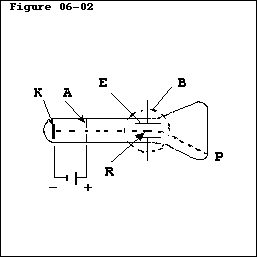
 and accelerated through the hole of the anode
  which has a high electric potential value of
  volt. The resting mass value
  of 1.6 x 10⁻¹⁹ coulomb. The accelerated electron travels with a velocity
  (perpendicular to Figure 06-02). The electron beam then strikes the fluorescent screen at point
  . The trajectory of the beam can be made visible, and it is possible to measure the radius of curvature
  in the magnetic field. Naturally, the flying electrons are also influenced by gravity, but one can easily demonstrate that this effect is negligible.