 0 to eliminate some dangerous tensions (stresses) inside the atomic structure.
0, let us look at Figure 10-01. We have the sun of the atom (nucleus) and the planetary units  0. These are the "intelligent" living gyroscopes, and they are embedded in an elastic gravitational field which is composed of secondary free atoms -10. I already explained the different patterns created by the -10-s in Chapter 03. Here, I am adding that the gravitational field also assures the revolution (orbital motion) of the planets 0 around the atomic sun. An electric tension can be caused by the deviation of the 0 gyroscope's axis. This "living" gyroscope has a powerful orientation organ
  0b which tries to orient the axis in the most favourable position in order to assure a fast rotation. In a perfectly neutral position, the 0 axis would be perpendicular to the plan of its orbit. This would be an ideal situation which does not exist in Nature. This means that each 0 atom always has a kind of electric tension. However, we can only observe those which are of sufficient magnitude to be recorded by our instruments.
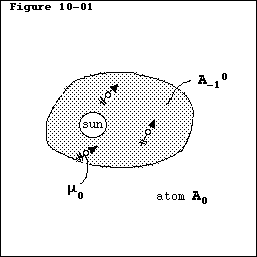
Remark: It is interesting to compare the planetary units 0 with the planets +1 in our solar system +1. We know that the axis of our planet earth is also slightly deviated. (Without this deviation, we would not experience the four seasons.) We could also imagine that a cosmic giant could interpret the deviation of the earth as a kind of electric tension. In my opinion, such little deviation does not translate into a serious "electric" phenomenon in a higher level atom +2. A +2 giant would likely consider our solar system +1 to be electrically neutral.
0 would have to deviate much more radically in order to create for us appreciable electrical phenomena. The deviation can even change in each point of their orbit. So, it can happen that the axis are continuously directed in the same direction in the space.
0 deviation can jeopardise the stability of the atom 0. For this reason, Nature has
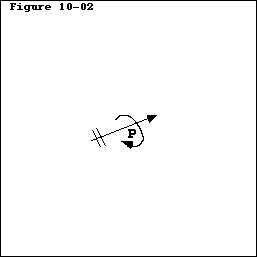
created a marvellous mechanism which tries to eliminate any excessive deviations and stresses in the gravitational field of the atom 0. The unstable secondary free atoms -10 create stabilising loops which encircle the 0 axis. In my writings, I call them polarisation loops, with the sign  -1. To represent the direction of the 0 axis, I use the sign
  .
.
is determined by the direction of the polarisation loop.
0 is present in the space of the +1, and forms different kinds of "confederations" with other 0. These confederations are called molecules. Each molecule is completely surrounded by free atoms 00. Even a rigid body is just a kind of "lattice" constituted by molecules and separated by 00-s. Thus, we should analyse separately the electrical behaviour of each molecule. This offers huge possibilities for researchers, as each individual molecule acts differently if it is electrically polarised.
Remark: We can omit the notion of electrical charge.
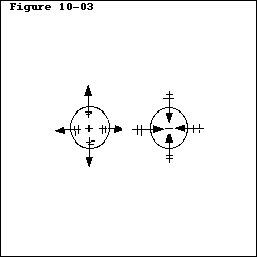
 ) polarisation. On the right, the arrows are pointed in the direction of
  ) polarisation. It is our choice to call either one positive or negative. Even more attractive is to use the symbol
  for positive, and the symbol
  for negative polarisation. We already know that the direction of the arrow determines the direction of the polarisation loops,
  or
or  .
.
 is created. This means an instantaneous elimination (discharge) of the electric tension, as shown in Figure 10-04.
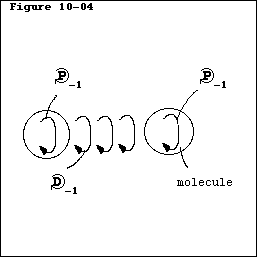
 . The new electrical term of capacity was introduced, and was represented by the letter
  . The capacity value is proportional to the number of deviated planetary units
  in). Sooner or later, the tension of the molecules is discharged because this is a natural tendency. But we can easily find a method to provoke an instantaneous discharge. Then, the involved living units (the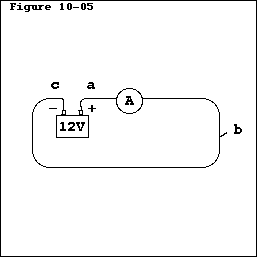
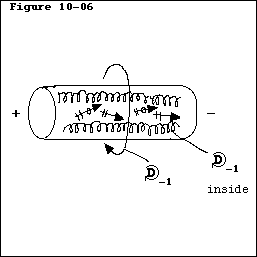
 0 particles are being ejected from its body. This is the "transpiration" mechanism of a living unit. The magnitude of the dispersing tubes depends on the number and characteristic of the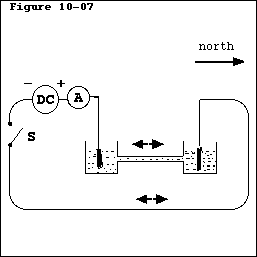
 , I was surprised to notice that only the compass needle above the conductor registered a slight deviation. This observation led me to believe that within the tube, there is no electric current or moving electrons. However, the inserted ammeter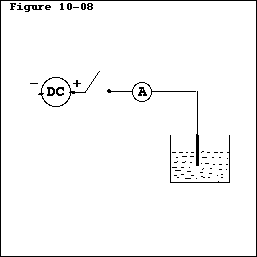


 ) in water, a chemical reaction occurs which creates a lot of positively and negatively polarised molecules. Science calls these "ions", but I consider them molecules whose planetary axes have been drastically deviated (