2000-11-25|Sunatori's Equilibrium (Magnetic Lagrange Point)
You asked for it
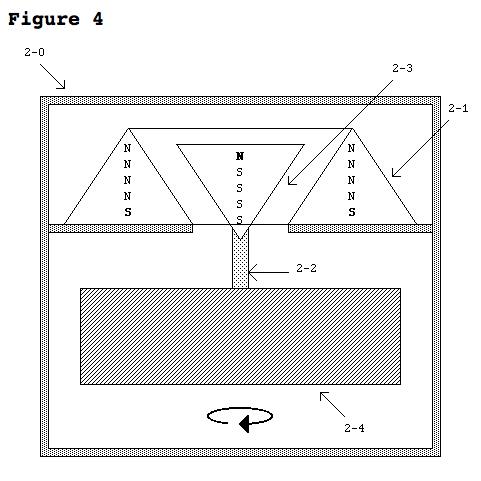
- Here is my proposal called "Magnetically Suspended Flywheel System", which is closer to the Levitron approach.
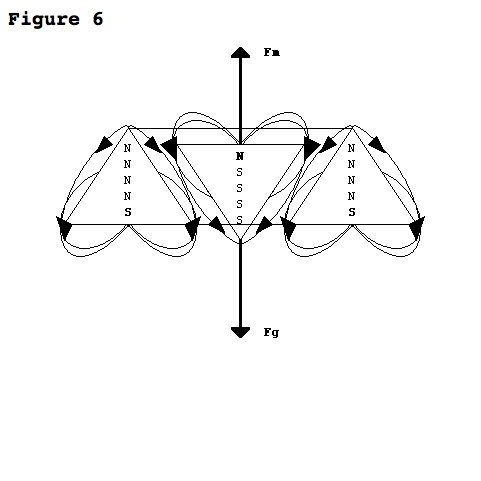
- The gravitational force is used to suppress "tilt" instability, just like the Post patent. The ring-shaped stator magnet forms inverse heart-shaped magnetic flux lines, and the cone-shaped rotor magnet forms heart-shaped magnetic flux lines. The stable magnetic flux line patterns at the air gap between the ring-shaped stator magnet and the cone-shaped rotor magnet provide axial stability and radial stability. These stabilities are due to a cone-shaped well in a toroidal magnetic field, which is formed by a concentrated first magnetic pole and a distributed second magnetic pole.
- Before you dismiss this flywheel system as a crackpot junk, please consider the following, as the late Bill Nye The Science Guy used to say :-).
- Rev. Samuel Earnshaw's Theorem assumes Coulomb's law. However, real magnets do not exactly follow the inverse square law (1/r^2), which predicts infinite force between like poles. Instead, like poles of real magnets stick to each other when forced. Here is a text of The Living Atom Theory (Chapter 13) explaining this point, although Uncle Al calls the author an idiot (what else is new?).
- Dipoles do not exactly follow the inverse square law (1/r^2) but follow the inverse cube law (1/r^3).
- The Lagrange Points between gravitational bodies in space provide stable equilibrium (L4, L5). There are equivalent Magnetic Lagrange Points to be discovered, along with "Sunatori Equilibrium".

- Thank you very much for your attention.
- Merci de votre attention.
Donation
[Go to]
[Mail any comments or suggestions to]
[Credit]
- Copyright © 1995 by HyperInfo Canada Inc.
- All rights reserved.
- Produced in Canada.
- ISBN 0-929105-04-4
- 2004-04-02T03:23:33,0
[Search/Recherche]
[Advertisement/Publicité]